
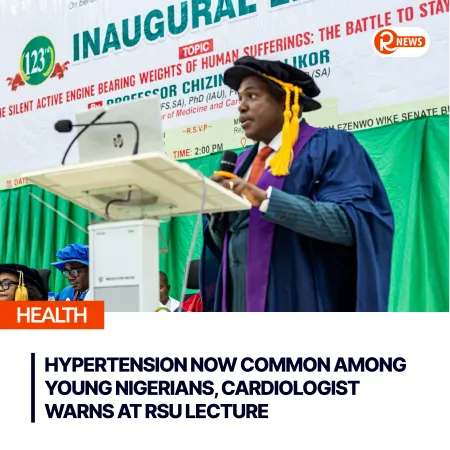
A consultant cardiologist, Professor Chizindu Alikor, has raised alarm over the rising incidence of hypertension among young Nigerians, warning that high blood pressure is “no longer a sickness for the old,” as even 18-year-olds are now being diagnosed.
Professor Alikor sounded the warning while delivering the 123rd Inaugural Lecture of the Rivers State University (RSU) on Wednesday. His lecture, titled “The Silent Active Engine Bearing Weights of Human Sufferings: The Battle to Stay Alive,” examined the growing strain on the human heart and the lifestyle choices endangering cardiovascular health.
Lifestyle Choices Now the Biggest Threat to the Heart
Describing the heart as “the silent active engine” that works relentlessly to sustain life, Professor Alikor—who is also the Chief Medical Director of the Rivers State University Teaching Hospital (RSUTH)—said modern lifestyles have become the greatest contributors to cardiovascular diseases.
“Lifestyle decisions impact the heart,” he said, listing excessive salt intake, high refined sugar, stress, obesity, poorly managed diabetes, and untreated hypertension as major drivers of heart disease.
“These are components in the domains of suffering that impact negatively on the human heart,” he added.
To address the crisis, he unveiled the Alikor Survival Network Model, a holistic approach that places responsibility on individuals, families, and the healthcare system.
Hypertension Rising Among Young Adults and Rural Populations
Professor Alikor, who also serves as President of the Nigerian Society of Nuclear Medicine and Molecular Imaging, revealed that his earlier collaborative research conducted over 20 years ago already showed a high level of cardiovascular risk factors in the Niger Delta.
More worrying, he said, is the increasing trend of hypertension among young people and rural dwellers, noting that clustering of cardiovascular risk factors among Nigerians aged 18 to 39 is now as high as 15 percent.
He questioned what the current situation might be in urban areas where traditional diets and physical activity have been replaced with fast foods and sedentary lifestyles.
“Urbanization has wiped away the traditional diet and leg walk and has brought us to a sedentary lifestyle,” he warned.
He further disclosed that men show a higher prevalence of cardiovascular risk clusters than women.
Heart Failure and Stroke Dominate Niger Delta Hospital Cases
According to the cardiologist, heart failure and stroke remain the most common cardiovascular complications among hospitalized patients in the Niger Delta.
He advised Nigerians never to ignore symptoms such as palpitations, describing them as danger signs that require immediate evaluation by a cardiologist.
“The battle to stay alive is a collective project and not an individual endeavor,” he said, emphasizing that applying the Alikor Heart Survival Network Model could protect both individuals and communities.
Diet and Regular Monitoring Are Critical
Highlighting diet as the first line of defense, Professor Alikor recommended meals rich in vegetables, fruits, legumes, and whole grains while warning against foods high in salt, trans fat, and refined sugar—describing them as “enemies of the silent active engine.”
He urged Nigerians to “know your numbers,” including blood pressure, blood sugar, and cholesterol levels, and encouraged regular home monitoring.
“In our study, we established that even among the very educated, some move around with 200/150—university professors—just moving around,” he said.
“You need to have your blood pressure monitors… keep them in the office and by your bedsides and check your blood pressure regularly.”
He also referenced Luke 22:44, saying the scripture underscores the physiological stress the human heart can endure.
Processed Foods and Falling Physical Activity Driving Future Crisis
Professor Alikor warned that Nigeria is undergoing an epidemiologic transition marked by increasing reliance on processed and fast foods, which, combined with physical inactivity, could trigger a surge in cardiovascular emergencies.
“If nothing is done, in the next 10 to 20 years, there will be an alarming increase in heart attacks and stroke,” he said.
He proposed the Alikor Health Care Survival Model as part of the solution.
RSU Reaffirms Commitment to Research-Driven Solutions
Earlier, the Vice Chancellor of Rivers State University, Professor Isaac Zeb-Obipi, reaffirmed the institution’s commitment to addressing societal challenges through research.
He noted that daily stress, poor infrastructure, unemployment, poverty, and unhealthy habits place significant strain on vital organs—including the heart—reducing productivity and quality of life.
He said the culture of inaugural lectures at RSU is intended to generate sustainable solutions to pressing national issues.