
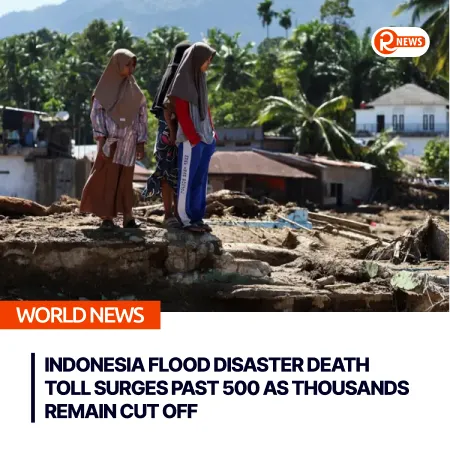
The death toll from the devastating floods that struck Indonesia last week has risen to more than 500, with rescuers still struggling to reach remote communities trapped by debris, destroyed roads, and widespread power outages.
The catastrophic flooding was triggered by a rare cyclone that formed over the Malacca Strait, inundating three provinces and affecting 1.4 million people, according to Indonesia’s national disaster agency. At least 500 more people remain missing, while thousands are injured.
The humanitarian crisis comes amid a wave of torrential rains across parts of Asia, with Thailand, Malaysia and Sri Lanka also reporting casualties from severe weather.
Entire Communities Cut Off
The worst-hit regions include Aceh, North Sumatra and West Sumatra, where entire communities remain isolated without food, water, or communication.
Arini Amalia, a resident of Aceh’s Pidie Jaya Regency, described the scale of the flooding as unprecedented.
The floodwaters, she told the BBC, had been “like a tsunami.”
“According to my grandmother, this is the worst, the worst in her life,” she said.
With many roads destroyed, aid workers have been forced to reach survivors on foot or by motorcycle, as trucks and rescue vehicles cannot pass. Images from the disaster zone show collapsed bridges, mud-choked roads, and uprooted trees stacked in towering piles.
In West Sumatra, hopes of finding survivors are fading. At the Twin Bridges landmark, where torrents swept through and buried homes under thick mud, Mariana watched anxiously as excavators worked to clear debris while she waited for news of her missing loved ones—including her 15-year-old son.
“Watching the excavators, seeing how thick the mud is… I keep thinking, what condition will my child be in when they find him?” she said.
“Will he still be intact?
My mother, my brother-in-law…
Looking at how it is here, maybe their faces won’t even be recognisable any more.”
Food Scarcity Deepens Suffering
For many survivors, hunger has become a growing emergency.
Maysanti, from Central Tapanuli—one of North Sumatra’s worst-hit regions—said aid has not reached her district.
“Everything is gone; our food supplies are running out. We can’t eat,” she said.
“Even instant noodles are being fought over now. Our food is gone; we need food and rice. Access to us is completely cut off.”
She added that she has to walk several kilometres just to access mobile signal or clean water.
In Central Aceh, thousands queued late into Sunday night outside the regency’s office to use Starlink devices installed by local authorities. With telecommunications down for days, many were desperate to contact family members or charge their phones.
“It’s been five days with no signal… I’m planning to call my mother in Banda Aceh, but until now I still can’t reach her,” said a resident named Mar.
Criticism Mounts Over Government Response
As the death toll rises, frustration has grown over what many describe as a slow and disorganized government response. Critics accuse authorities of being poorly prepared for the floods and of allowing bureaucratic delays to hinder food distribution.
During a visit to flood-hit areas in North Sumatra on Monday, President Prabowo Subianto acknowledged the challenges, admitting that some areas were still inaccessible.
But he insisted the government was working tirelessly to address the crisis.
“We’re doing everything we can to overcome difficulties,” he said.
“We face this disaster with resilience and solidarity.
Our nation is strong right now, able to overcome this.”